November 8th, 1pm EST
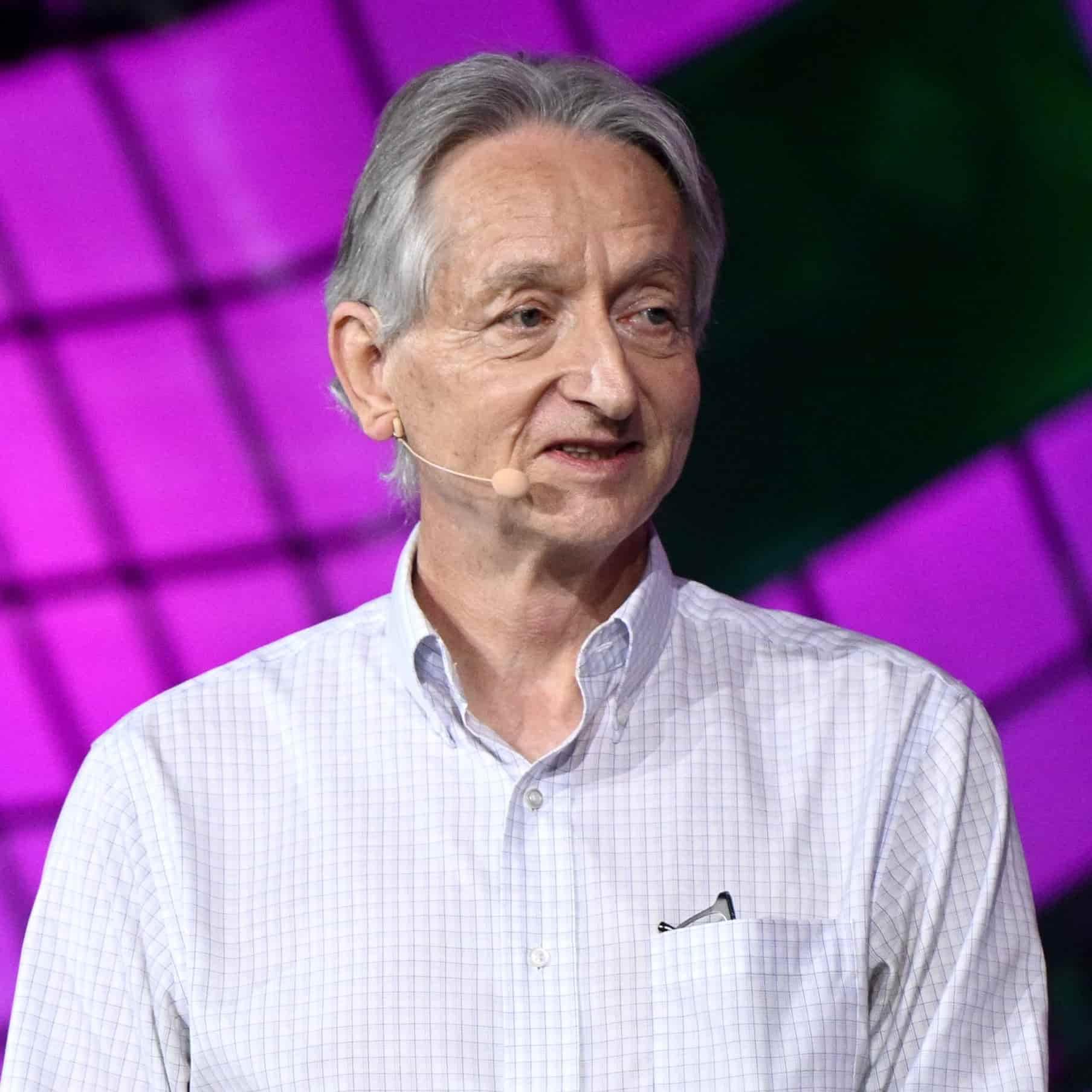
Dr. Geoffrey Hinton, renowned as the 'godfather of deep learning', is a cognitive psychologist and computer scientist who has revolutionized the field of artificial intelligence. Awarded the 2018 Turing Award alongside Yoshua Bengio and Yann LeCun, his pioneering work on artificial neural networks and deep learning algorithms has been instrumental in propelling machine learning and AI to new heights. Dr. Hinton's groundbreaking research continues to drive innovation across numerous industries, from healthcare to autonomous systems, reshaping our understanding of machine intelligence.
Question of the Day
“If neural networks can learn by 'dreaming' -- generating and unlearning their own data -- what does that tell us about why humans dream?”
Insight: Hinton showed that Boltzmann machines use a 'sleep' phase to unlearn spurious patterns, mathematically matching Crick's theory that biological dreaming serves to clean up neural connections. The parallel suggests dreams may literally be the brain's way of optimizing its model of reality.
Talk Highlights: Hopfield Networks, Boltzmann Machines, and the Beautiful Math Behind Learning
Geoffrey Hinton presented the history and mechanics of Hopfield networks and Boltzmann machines, explaining how symmetric recurrent networks use energy functions to store memories and perform perception. He showed how Boltzmann machines derive an elegantly simple learning rule based on the difference between 'awake' and 'dream' phase correlations, connected this to Crick's theory of dreams, and explained how restricted Boltzmann machines became the key to initializing deep neural networks -- opening the floodgates for modern deep learning. He also addressed the Nobel Prize rationale and AI safety.
Key Takeaways
- The Boltzmann machine learning rule is remarkably simple: the weight update between two neurons is just the difference between how often they activate together when processing real data ('awake') versus when the network freely generates its own data ('dreaming'). No backpropagation is needed.
- Hinton explained that the Nobel Prize in Physics for AI had to be justified through a 'very thin thread' connecting restricted Boltzmann machines to the initialization of backpropagation networks during 2006-2011.
- He believes the data bottleneck for AI will be overcome by having large models generate their own training data through reasoning, analogous to how AlphaZero uses Monte Carlo rollouts.
- On AI safety, Hinton warned that it now costs only about $100,000 to design a pathogen like COVID using AI, meaning a cult with a million dollars could design ten and release them simultaneously.
Notable Quotes
“When you're asleep, if two units are on together you decrease the strength of the connection -- you're making the configurations you get when you're asleep less likely, and making the configurations from when you're awake more likely. This is just like the Crick theory that you're unlearning during sleep, but this is actually the derivative of something.”
“I think what's going to happen is we're going to get these big models generating their own data in the same way that AlphaZero does, and that's going to overcome the data bottleneck, and then scaling will take us as far as we want to go.”
“It now only costs about a hundred thousand dollars to design a pathogen like COVID, and so a cult with a million dollars could design ten of them and release them all at once.”
Biography +
Geoffrey Hinton
Early Life and Education
Geoffrey Everest Hinton was born on December 6, 1947, in Wimbledon, London, England. He was educated at Clifton College in Bristol and later attended King's College, Cambridge. Initially, Hinton switched between various subjects such as natural sciences, history of art, and philosophy before finally graduating with a Bachelor of Arts in experimental psychology in 1970 from the University of Cambridge. He went on to pursue a PhD in artificial intelligence at the University of Edinburgh, which he was awarded in 1978. His research was supervised by Christopher Longuet-Higgins source.
Academic Career
After obtaining his PhD, Hinton worked at the University of Sussex and later at the University of California, San Diego, and Carnegie Mellon University. He faced difficulties in securing funding in Britain, which led him to positions in the United States. Hinton was the founding director of the Gatsby Charitable Foundation Computational Neuroscience Unit at University College London. He is currently a professor in the computer science department at the University of Toronto, where he holds a Canada Research Chair in Machine Learning. Hinton is also an advisor for the Learning in Machines & Brains program at the Canadian Institute for Advanced Research as of June 2024 source.
Contributions to Neural Networks
Hinton is most noted for his contributions to the field of artificial neural networks and deep learning, earning him the title "Godfather of AI." In 1986, along with David Rumelhart and Ronald J. Williams, he co-authored a highly cited paper that popularized the backpropagation algorithm for training multi-layer neural networks. Although not the first to propose backpropagation, their work significantly advanced its application source.
In 1985, Hinton co-invented Boltzmann machines with David Ackley and Terry Sejnowski. His other notable contributions include distributed representations, time delay neural networks, mixtures of experts, and Helmholtz machines source.
Achievements and Awards
Hinton has received numerous prestigious awards for his work, including:
- AAAI Fellow (1990)
- Rumelhart Prize (2001)
- IJCAI Award for Research Excellence (2005)
- IEEE Frank Rosenblatt Award (2014)
- James Clerk Maxwell Medal (2016)
- BBVA Foundation Frontiers of Knowledge Award (2016)
- Turing Award (2018)
- Dickson Prize (2021)
- Princess of Asturias Award (2022)
He received the 2018 Turing Award along with Yoshua Bengio and Yann LeCun for their work on deep learning, earning them the moniker "Godfathers of Deep Learning" source.
Industry Contributions and Resignation from Google
Hinton co-founded and became the chief scientific advisor of the Vector Institute in Toronto in 2017. From 2013 to 2023, he divided his time working at Google Brain and the University of Toronto. He publicly announced his departure from Google in May 2023, citing concerns about the risks associated with artificial intelligence technology. Hinton has voiced concerns about malicious use of AI, technological unemployment, and existential risks from artificial general intelligence. He emphasized the need for safety guidelines and cooperation among AI developers to mitigate these risks source.
Legacy and Influence
Hinton's influence extends through his numerous students and collaborators, many of whom are leading figures in AI and machine learning. Notable students include Ilya Sutskever, who co-founded OpenAI, and Yann LeCun, a key figure in the development of convolutional neural networks.
Hinton's research has had a profound impact on the field of computer vision, particularly through the development of AlexNet, in collaboration with his students Alex Krizhevsky and Ilya Sutskever, which won the ImageNet challenge in 2012. This was a significant breakthrough in the field of computer vision source.
Personal Life
Hinton's personal website can be found here, where more information about his work and publications is available.
Conclusion
Geoffrey Hinton's pioneering work in artificial neural networks and deep learning has earned him a place as one of the foremost experts in the field. His contributions have shaped modern AI research and applications, making a lasting impact on both academia and industry. Through his efforts, Hinton continues to influence the direction of AI research and its ethical considerations.
Career Timeline +
Career Timeline
- 1970: Graduated from the University of Cambridge with a Bachelor of Arts in experimental psychology source
- 1978: Received Ph.D. in Artificial Intelligence from the University of Edinburgh source
- 1985: Co-invented Boltzmann machines with David Ackley and Terry Sejnowski source
- 1986: Co-authored a highly influential paper on backpropagation algorithm source
- 1990: Elected as a Fellow of the Association for the Advancement of Artificial Intelligence (AAAI) source
- 2001: Awarded the Rumelhart Prize source
- 2005: Received the IJCAI Award for Research Excellence source
- 2013: Joined Google Brain while maintaining his position at the University of Toronto source
- 2014: Awarded the IEEE Frank Rosenblatt Award source
- 2016: Received the James Clerk Maxwell Medal and BBVA Foundation Frontiers of Knowledge Award source
- 2017: Co-founded the Vector Institute in Toronto source
- 2018: Awarded the ACM A.M. Turing Award source
- 2021: Received the Dickson Prize source
- 2022: Awarded the Princess of Asturias Award source
- 2023: Resigned from Google, citing concerns about AI risks source
Content produced by Turing Minds. Usage guidelines.